
Buying a home is one of the biggest financial decisions most people will ever make. For many families, owning a house is not just about having a place to live — it is about security, stability, and building long-term wealth.
But with property prices continuing to rise, very few people can buy a home with cash. That is why home loans, also called mortgages, play such an important role in making homeownership possible.
A home loan allows you to buy property now and repay the amount over many years through monthly installments. But while a mortgage can help you achieve your dream of owning a home, choosing the wrong loan can cost you thousands — sometimes even millions — in extra interest over time.
The biggest mistake many borrowers make is focusing only on the monthly payment. They do not compare lenders, they ignore hidden charges, and they do not fully understand how interest rates work. As a result, they end up with expensive loans that create long-term financial pressure.
This complete 2026 mortgage guide explains how affordable home loans work, how to qualify for low interest rates, what documents you need, how Islamic home financing differs from conventional mortgages, and how to avoid common borrowing mistakes.
Whether you are buying your first home, upgrading to a larger property, or exploring refinancing options, this guide will help you make a smarter and more confident decision.
What Is a Home Loan?
A home loan, also known as a mortgage, is a long-term loan used to purchase property.
The lender — usually a bank, Islamic bank, or housing finance company — provides money to help you buy the home. You then repay the loan over time with interest or an agreed financing structure.
Most home loans are repaid through monthly installments, often called EMIs.
A mortgage is usually secured by the property itself. This means if the borrower fails to repay the loan, the lender may have the legal right to take possession of the property.
Key Features of a Home Loan
Most home loans include the following features:
- Long repayment period, usually 10 to 30 years
- Monthly payments or EMIs
- Lower interest rates than personal loans
- Property used as collateral
- Fixed or variable interest rate options
- Down payment requirement
- Legal and processing fees
Because home loans are long-term commitments, even a small difference in interest rate can make a big difference in total repayment cost.
Why Home Loans Are Important
Home loans are important because they make property ownership possible for people who cannot pay the full amount upfront.
Instead of waiting decades to save enough money, borrowers can buy a property earlier and repay gradually.
A home loan can help you:
- Buy a house or apartment
- Build long-term family security
- Invest in property
- Reduce dependency on rent
- Create an asset for the future
For many families, a home is the largest asset they will ever own.
Types of Home Loans in 2026
Understanding different mortgage types helps you choose the best option for your financial situation.
1. Fixed-Rate Home Loan
A fixed-rate home loan has an interest rate that remains the same for a fixed period or the entire loan term.
This means your monthly payment stays predictable.
Best For
Fixed-rate loans are best for borrowers who want stability and do not want surprises in monthly payments.
Pros
- Predictable EMIs
- Easier budgeting
- Protection from rising interest rates
Cons
- Initial rate may be slightly higher
- Less benefit if market rates fall
A fixed-rate mortgage is often suitable for long-term homeowners who value financial certainty.
2. Variable or Adjustable-Rate Home Loan
A variable-rate home loan has an interest rate that can change over time based on market conditions.
The initial rate may be lower than a fixed-rate loan, but it can increase later.
Best For
Variable-rate loans may suit borrowers who expect interest rates to fall or plan to repay early.
Pros
- Lower starting rate
- Possible savings if rates decrease
- More flexible in some cases
Cons
- Monthly payments may increase
- Harder to budget long term
- Riskier during rising-rate periods
Borrowers should be careful with variable-rate loans because affordable payments today may become expensive later.
3. Islamic Home Financing
In countries like Pakistan and other Muslim-majority regions, many buyers prefer Islamic home financing because it avoids traditional interest, also known as riba.
Islamic home financing follows Shariah-compliant structures based on trade, leasing, or shared ownership.
Common Islamic home financing options include:
- Murabaha
- Ijarah
- Diminishing Musharakah
Murabaha
In Murabaha financing, the bank buys the property and sells it to the customer at an agreed profit margin.
The total price is known upfront, making the structure transparent.
Ijarah
Ijarah is similar to leasing.
The bank owns the property and leases it to the customer. The customer makes rental payments, and ownership may transfer later depending on the agreement.
Diminishing Musharakah
Diminishing Musharakah is based on shared ownership.
The bank and customer jointly own the property at the start. Over time, the customer gradually buys the bank’s share until full ownership is transferred.
Benefits of Islamic Home Financing
- Shariah-compliant
- Transparent structure
- Ethical financing model
- Popular in Pakistan and Islamic banking markets
Islamic financing may be a good option for borrowers who want a religiously compliant alternative to conventional mortgages.
4. Government Housing Schemes
Some governments offer housing finance programs to support first-time buyers and low-to-middle-income families.
These schemes may include:
- Subsidized interest rates
- Lower down payment requirements
- Easier eligibility rules
- Support for affordable housing projects
Government-backed home loans can be especially helpful for first-time buyers.
How Home Loan Interest Rates Work
The interest rate is the cost of borrowing money.
A lower interest rate means you pay less over the life of the loan. A higher rate increases both your monthly payment and total repayment amount.
In 2026, typical home loan interest rates may fall into these ranges:
| Borrower Profile | Typical Mortgage Rate |
|---|---|
| Low-risk borrowers | 7% – 10% |
| Average borrowers | 10% – 15% |
| High-risk borrowers | 15%+ |
Actual rates depend on your country, lender, credit profile, income, property type, and market conditions.
Why Low Interest Rates Matter
Many borrowers underestimate how powerful interest rates are.
A difference of just 1% or 2% may seem small, but over a 20- or 30-year mortgage, it can cost a huge amount.
A low interest rate can help you:
- Reduce monthly payments
- Save money over time
- Pay off your loan faster
- Improve affordability
- Lower financial stress
This is why comparing mortgage offers is one of the most important steps before buying a home.
Factors That Affect Your Mortgage Rate
Lenders do not offer the same rate to every borrower. Your rate depends on your financial profile and the property you are buying.
1. Credit Score
Your credit score is one of the most important factors.
A higher credit score shows lenders that you are responsible with debt. This can help you qualify for lower interest rates.
To improve your credit score:
- Pay bills on time
- Reduce existing debt
- Avoid missed payments
- Keep credit card balances low
- Do not apply for too many loans at once
2. Income Stability
Lenders prefer borrowers with stable and reliable income.
Salaried employees, business owners with consistent income, and professionals with strong financial records usually have better approval chances.
A stable income tells the lender you can manage monthly payments.
3. Loan Amount
A larger loan creates more risk for the lender.
If you borrow too much compared to your income, the lender may charge a higher rate or reject the application.
4. Property Value and Location
The property itself matters.
Homes in prime locations are often easier to finance because they usually have stronger resale value.
Lenders may also evaluate:
- Property condition
- Legal documentation
- Market value
- Location demand
- Construction quality
5. Down Payment
A larger down payment reduces lender risk.
If you pay 20% to 30% upfront, you may qualify for better terms because the loan amount is smaller.
A higher down payment also reduces your monthly EMI.
How to Find an Affordable Home Loan
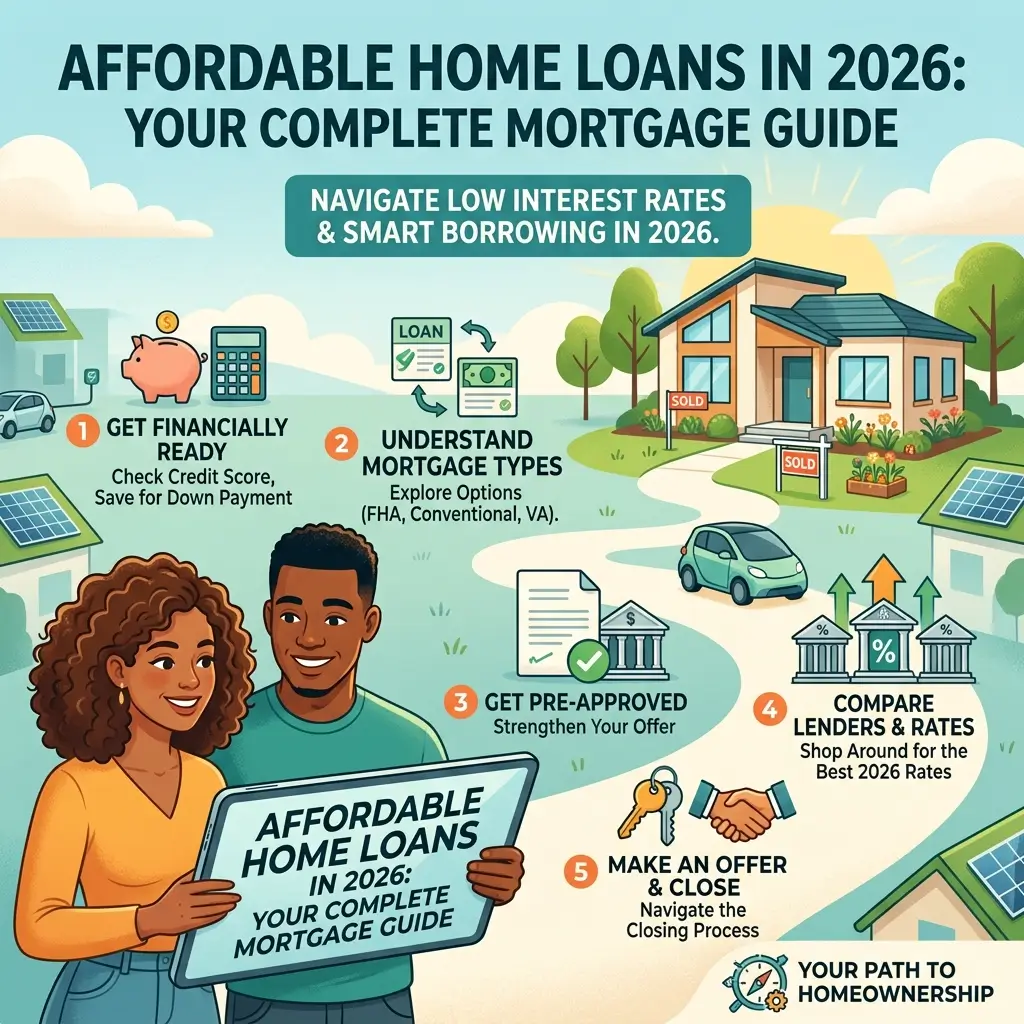
Finding an affordable mortgage is not about choosing the first bank that approves you. It requires comparison, planning, and understanding the total cost.
Step 1: Compare Multiple Lenders
Always compare at least three lenders before choosing a mortgage.
Check offers from:
- Banks
- Islamic banks
- Housing finance companies
- Credit unions
- Online lenders
- Government-backed programs
Different lenders may offer different rates, fees, and repayment conditions.
Step 2: Compare Fixed vs Variable Rates
Do not choose a rate type without understanding the risk.
A fixed-rate loan is better if you want stable payments.
A variable-rate loan may start cheaper, but it can become expensive if rates rise.
For most first-time buyers, fixed-rate loans are easier to manage because payments are predictable.
Step 3: Understand the Total Cost
The lowest interest rate is not always the cheapest loan.
You also need to check:
- Processing fees
- Legal charges
- Valuation fees
- Insurance costs
- Early repayment penalties
- Documentation fees
- Late payment charges
A loan with a slightly higher rate but fewer fees may sometimes be better than a low-rate loan with heavy hidden charges.
Step 4: Choose the Right Loan Tenure
Loan tenure has a major impact on affordability.
A longer tenure gives you a lower EMI, but you pay more total interest.
A shorter tenure increases your monthly payment, but reduces total interest cost.
Example
A 30-year loan may feel affordable every month, but the total interest paid can be much higher than a 15-year or 20-year loan.
Choose a tenure that balances monthly comfort with long-term savings.
EMI Explained: What Is a Monthly Mortgage Payment?
EMI stands for Equated Monthly Installment.
It is the fixed monthly amount you pay to the lender.
Your EMI depends on:
- Loan amount
- Interest rate
- Loan tenure
A lower EMI may look attractive, but it does not always mean the loan is cheaper.
Longer tenure reduces monthly EMI but increases total repayment.
Before accepting a loan, ask the lender for a full repayment schedule.
How Much Home Loan Can You Afford?
A safe rule is to keep your home loan EMI within 30% to 40% of your monthly income.
For example, if your monthly income is $2,000, your mortgage payment should ideally stay below $600 to $800.
You should also consider other expenses, such as:
- Utility bills
- Groceries
- Transport
- School fees
- Insurance
- Maintenance
- Emergency savings
Never borrow the maximum amount just because a lender approves it. Borrow what you can comfortably repay.
Documents Required for a Home Loan
Most lenders require detailed documentation before approving a mortgage.
Common documents include:
- CNIC, national ID, or passport
- Salary slips
- Business income records
- Bank statements for 6 to 12 months
- Tax returns, if required
- Employment details
- Property documents
- Sale agreement
- Property valuation report
- Proof of down payment
Self-employed borrowers may need extra documents, such as business registration, profit statements, or audited accounts.
Home Loan Eligibility Criteria
Eligibility requirements vary by lender, but most banks look for:
- Stable income
- Good credit history
- Acceptable debt-to-income ratio
- Age usually between 21 and 60 or 65 years
- Legal property documents
- Sufficient down payment
- Employment or business stability
The stronger your profile, the better your chances of approval and lower rates.
How to Lower Your Home Loan Interest Rate
You can improve your chances of getting a lower mortgage rate by preparing before applying.
1. Increase Your Down Payment
A larger down payment reduces the lender’s risk and lowers your loan amount.
This can help you secure better terms.
2. Improve Your Credit Score
Before applying, check your credit report and fix any issues.
Pay existing debts and avoid late payments.
3. Reduce Existing Debt
If you already have personal loans, credit card balances, or car loans, lenders may consider you risky.
Reducing debt improves your debt-to-income ratio.
4. Choose a Shorter Tenure
Shorter loan terms usually reduce total interest cost.
However, make sure the EMI is still affordable.
5. Negotiate with Lenders
Many borrowers do not negotiate, but banks may adjust rates for strong applicants.
If you have stable income, good credit, and a large down payment, use that as leverage.
6. Consider Islamic Financing
For some borrowers, Islamic home financing offers more transparent structures and predictable payments.
Compare both Islamic and conventional options before deciding.
Benefits of Home Loans
A well-structured home loan can provide several advantages.
1. Makes Homeownership Possible
Without mortgage financing, most people would not be able to buy a home.
2. Long Repayment Period
Home loans allow borrowers to spread payments over many years.
3. Lower Rates Than Personal Loans
Because the property acts as collateral, home loans usually have lower rates than unsecured loans.
4. Builds Long-Term Assets
Property can increase in value over time, helping you build wealth.
5. Possible Tax Benefits
In some countries, mortgage interest or payments may offer tax benefits.
Always check local rules or consult a tax professional.
Risks of Home Loans
Home loans are useful, but they also involve serious long-term responsibilities.
1. Long-Term Commitment
A mortgage can last 20 to 30 years.
Your income, family needs, and financial situation may change during that time.
2. High Total Interest Cost
Even with a low rate, long-term interest can be very expensive.
You may pay much more than the original loan amount over time.
3. Risk of Property Loss
If you fail to repay, the lender may take legal action and repossess the property.
4. Variable Rate Risk
If you choose a variable-rate mortgage, your payments may rise when interest rates increase.
Islamic vs Conventional Home Loans
Both Islamic and conventional financing can help you buy a home, but they work differently.
| Feature | Islamic Financing | Conventional Mortgage |
|---|---|---|
| Structure | Trade, lease, or partnership-based | Interest-based loan |
| Religious compliance | Shariah-compliant | Not Shariah-based |
| Availability | Limited in some regions | Widely available |
| Cost structure | Profit/rent-based | Interest-based |
| Best for | Shariah-conscious buyers | Buyers seeking broad lender choice |
The best option depends on your financial goals, religious preferences, and available offers.
Online vs Bank Branch Mortgage Application
In 2026, borrowers can apply for home loans online or through a physical bank branch.
Online Mortgage Application
Pros
- Faster comparison
- Convenient process
- Quick pre-approval
- Easier document upload
Cons
- Less personal guidance
- May not suit complex cases
Bank Branch Application
Pros
- Personalized support
- Better for first-time buyers
- Helpful for self-employed applicants
Cons
- Slower process
- More paperwork
If your case is simple, online applications may be faster. If your income or documents are complex, visiting a branch may be better.
Common Home Loan Mistakes to Avoid
Avoiding mistakes can save you a huge amount of money.
1. Not Comparing Loan Offers
Never take the first offer without checking alternatives.
Compare at least three lenders.
2. Ignoring Hidden Costs
Always ask for a full cost breakdown before signing.
Hidden charges can make a loan more expensive than expected.
3. Borrowing More Than You Can Afford
A large home may look attractive, but unaffordable EMIs can create long-term stress.
Stay within your budget.
4. Choosing the Wrong Interest Type
Variable rates can increase over time.
Understand the risk before choosing.
5. Focusing Only on EMI
A low EMI may mean a longer tenure and much higher total interest.
Always check total repayment cost.
Smart Borrowing Tips for 2026
To get an affordable home loan, follow these practical tips:
- Save a larger down payment
- Improve your credit score before applying
- Compare banks and Islamic lenders
- Choose a property within your budget
- Avoid unnecessary add-ons
- Read the full loan agreement
- Keep emergency savings
- Consider early repayment options
- Negotiate fees and rates
- Review refinancing options if rates drop
Smart borrowing is about long-term affordability, not just quick approval.
Frequently Asked Questions
Q1: What is the minimum down payment for a home loan?
Most lenders require 10% to 30% of the property value as a down payment, depending on the country, lender, and borrower profile.
Q2: Can I get a home loan with low income?
Yes, but your approved loan amount may be smaller. Lenders will check whether your EMI is affordable based on your income.
Q3: Is a fixed or variable-rate mortgage better?
A fixed-rate mortgage is better for stability. A variable-rate mortgage may be cheaper at first but can become risky if rates increase.
Q4: Can I repay my home loan early?
Yes, many lenders allow early repayment. However, some charge prepayment penalties, so always check the terms.
Q5: Is Islamic home financing cheaper than conventional mortgage?
Not always. Islamic financing may be more transparent and Shariah-compliant, but cost depends on the provider and structure.
Q6: How can I get the lowest mortgage rate?
Improve your credit score, increase your down payment, reduce existing debt, compare lenders, and negotiate before signing.
Final Thoughts: Choose a Home Loan That Fits Your Future
Getting an affordable home loan is not only about finding the lowest interest rate. It is about choosing a mortgage that fits your income, lifestyle, long-term goals, and financial stability.
A home should bring security — not constant financial stress.
Before applying for a mortgage, take time to compare lenders, understand the loan structure, calculate the total cost, and choose a monthly payment you can manage comfortably.
The smartest borrowers in 2026 are the ones who look beyond the advertised rate. They understand fees, tenure, down payment, repayment flexibility, and long-term affordability.
If you plan carefully, borrow responsibly, and choose the right financing option, a home loan can help you turn your dream of homeownership into a strong financial foundation for the future.